Translanguaging Course for Teachers: Practical Strategies

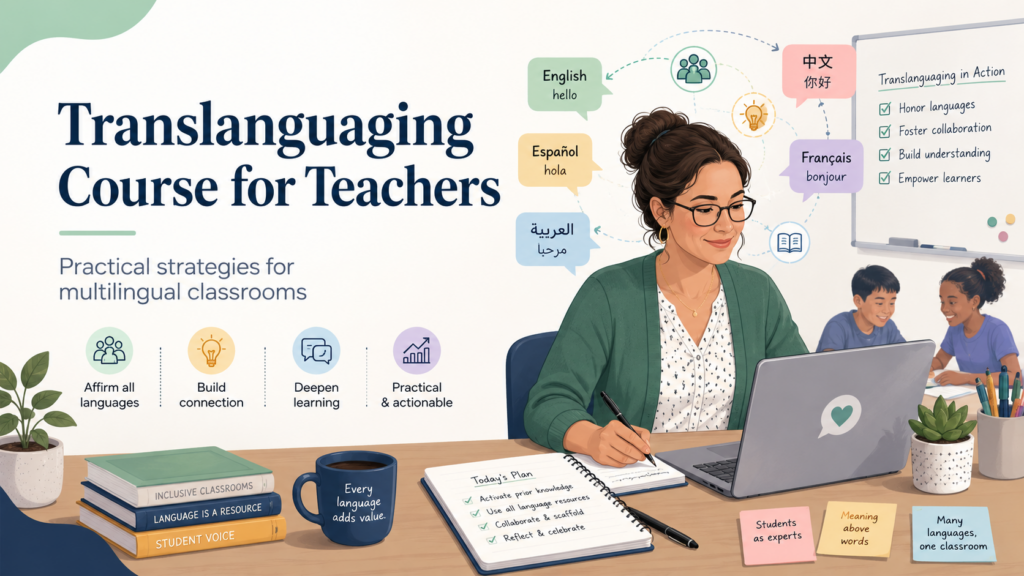
Practical Strategies for Multilingual Classrooms
If you teach multilingual learners, you may already know that their languages are an asset.
The harder question is usually:
What does that actually mean for my teaching?
Maybe you’ve heard the word translanguaging in a workshop, read about it online, or seen examples of students using multiple languages during a lesson.
But moving from “I understand the idea” to “I know how to use this tomorrow” can feel like a much bigger leap.
That’s exactly where a practical translanguaging course for teachers can help.
Good translanguaging professional development shouldn’t leave you with a pile of theory and no idea what to do with it. It should help you understand why multilingual approaches support learning, recognize opportunities that already exist in your classroom, and make intentional changes to your teaching without redesigning your entire curriculum.
What Is Translanguaging?
Translanguaging is an approach to teaching and learning that allows multilingual students to draw on their full linguistic repertoire to think, understand, communicate, and learn.
That might mean a student:
- discusses a difficult concept in their home language before responding in English
- takes notes using more than one language
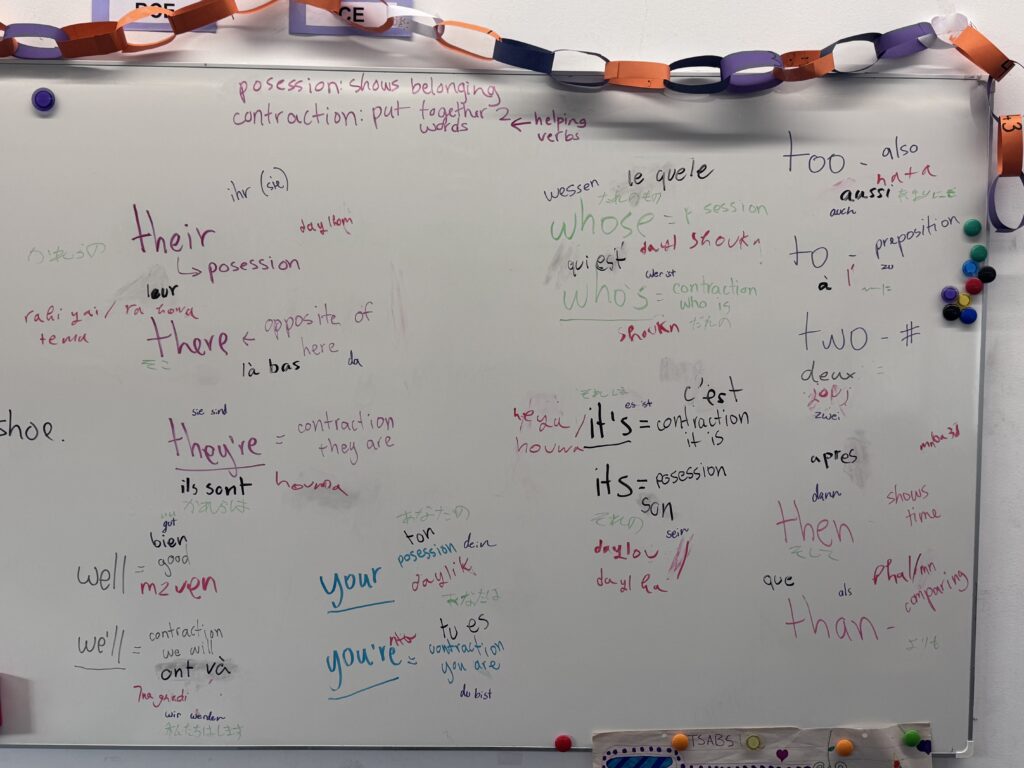
- compares vocabulary or sentence structures across languages
- reads information in one language and uses it to complete a task in another
- draws on cultural and linguistic knowledge to make sense of a new concept
The goal isn’t to replace English instruction.
It is to recognize that multilingual students do not stop knowing their other languages when they enter an English-medium classroom.
Those languages remain part of how they think.
And teachers can use that.
Why Teachers Need More Than a List of Translanguaging Strategies
One of the reasons I created The Translanguaging Mindset was that I kept seeing translanguaging discussed as an important idea, but teachers were given very little help translating that idea into everyday classroom practice.
The research was there. The theory was there.
What was harder to find was the practical bridge: What does this actually look like during a lesson? What can I do tomorrow?
That was the gap I wanted to address. So, I rolled up my sleeves and developed practical routines and examples grounded in what worked in multilingual classrooms.
“Let students discuss in their home language.”
“Use bilingual glossaries.”
“Allow multilingual notes.”
Those can all be useful.
But translanguaging becomes much more powerful when teachers understand the thinking underneath the strategies.
For example, imagine a student understands a science concept deeply in Arabic but doesn’t yet have the English vocabulary to explain everything they know.
An English-only classroom can accidentally turn that into a language test.
A translanguaging approach asks a different question:
How can we use the knowledge and language this student already has to help them access the learning?
That shift affects far more than one activity.
It changes how we think about prior knowledge, classroom participation, scaffolding, assessment, academic language, and even what counts as evidence that a student understands something.
That is why strong translanguaging training needs to address both practice and mindset.
What Should a Translanguaging Course for Teachers Include?
If you’re considering a translanguaging course or professional development program, I would look for a few things.
1. A clear explanation of translanguaging
You shouldn’t need a linguistics degree to understand the course.
Teachers need enough theory to make informed instructional decisions, but the research should connect directly to the classroom.
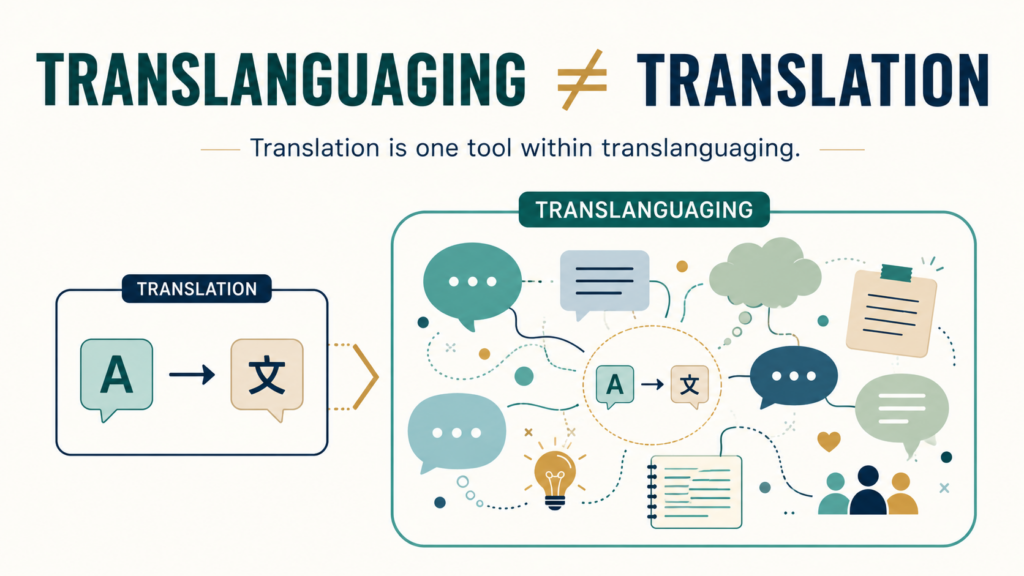
That includes understanding what translanguaging is, what it isn’t, and how it differs from translation.
2. Practical classroom applications
A good course should show you what translanguaging can actually look like during teaching and learning.
That might include ways students can use language to:
- activate prior knowledge
- process complex ideas
- collaborate with classmates
- develop academic language
- demonstrate understanding
- make connections across languages and cultures
And no, this does not mean creating twelve versions of every worksheet. Some of the most effective changes are tiny: you might change one discussion prompt, add an opportunity for multilingual processing, ask students to compare how an idea is expressed across languages, or maybe give them two minutes to think together before requiring an English response.
Small instructional choices can open much bigger doors.
3. Strategies that work even when you don’t speak your students’ languages
This is one of the biggest concerns I hear from teachers:
“But I don’t speak their language.”
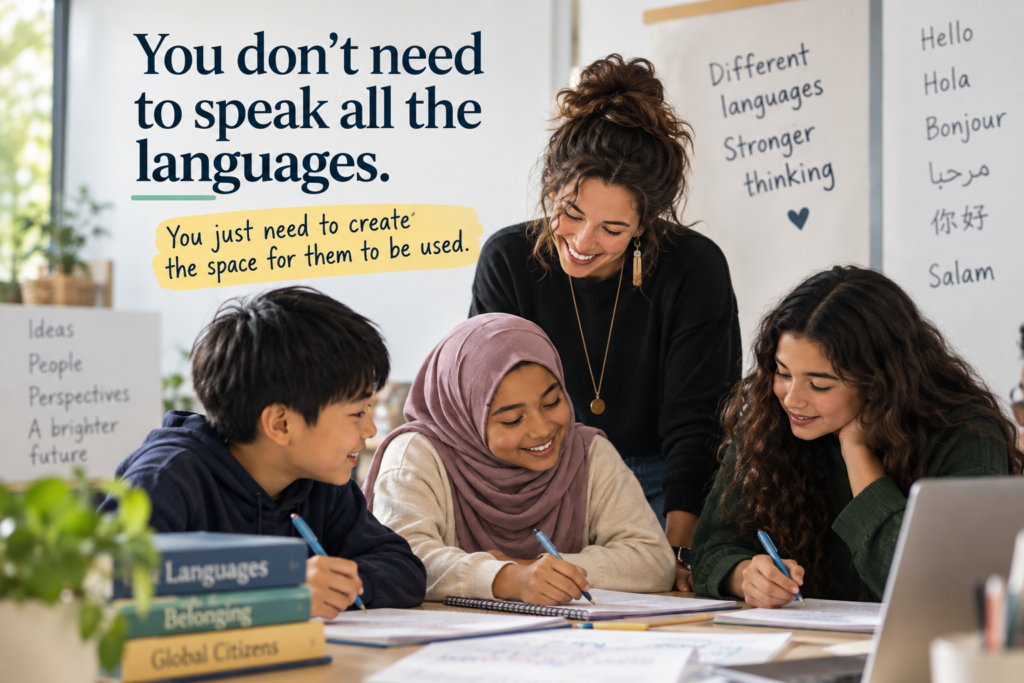
You don’t need to! Your role is not to understand every conversation happening in every language. In fact, that’s great.
Your role is to create structures that allow students to use their linguistic resources purposefully.
That could mean encouraging students to discuss an idea together before sharing with the class, utilizing multilingual resources, inviting students to annotate texts in the language that supports their thinking, or asking them to explain connections they notice between languages.
A translanguaging classroom does not require a multilingual teacher.
It requires a teacher who understands that multilingualism can be part of learning.
4. Attention to identity and belonging
Language is not only a communication tool.
It is connected to identity.
When a student’s home language is consistently absent from academic spaces, students can receive a subtle message about which parts of their knowledge and identity belong at school.
The opposite is also possible.
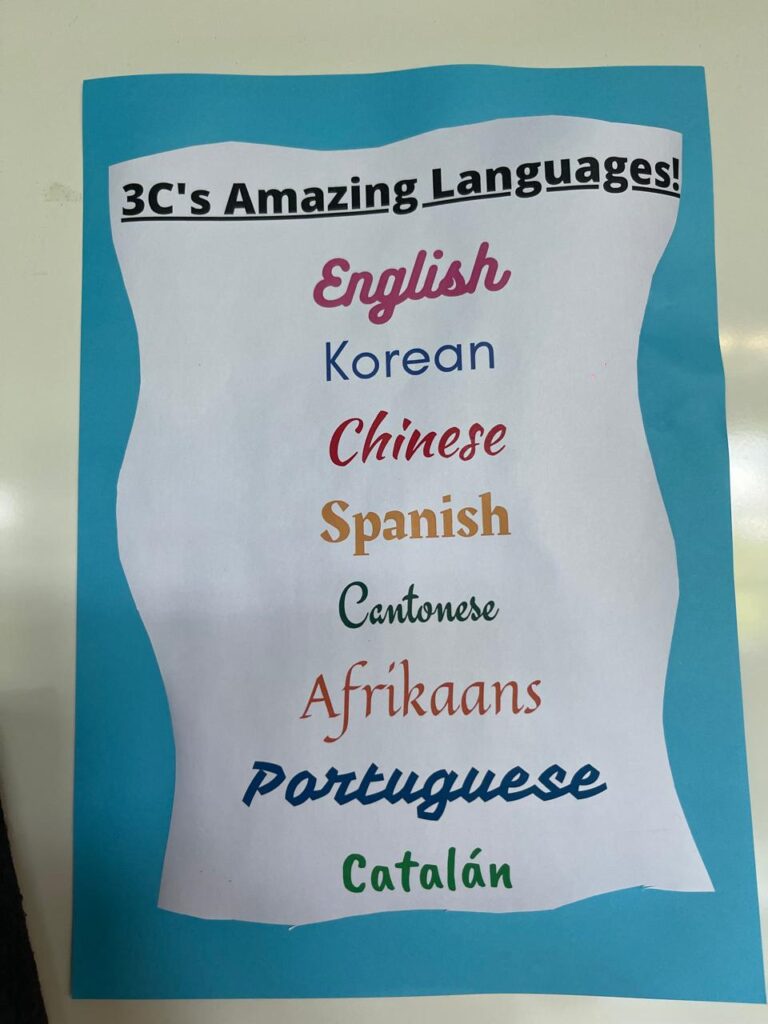
When students’ languages become visible, useful, and valued within learning, multilingualism can become something students recognize as an academic strength.
That is why a translanguaging mindset is about more than helping students understand vocabulary.
It’s also part of building classrooms where multilingual learners are encouraged to participate as their whole selves.
5. Something you can actually finish
Teachers are busy.
Professional development does not become more useful simply because it takes 40 hours.
Sometimes what teachers need is a focused introduction that gives them enough understanding to change what happens in their classrooms, and then space to keep learning through practice.
An Online Translanguaging Course Designed for Busy Teachers
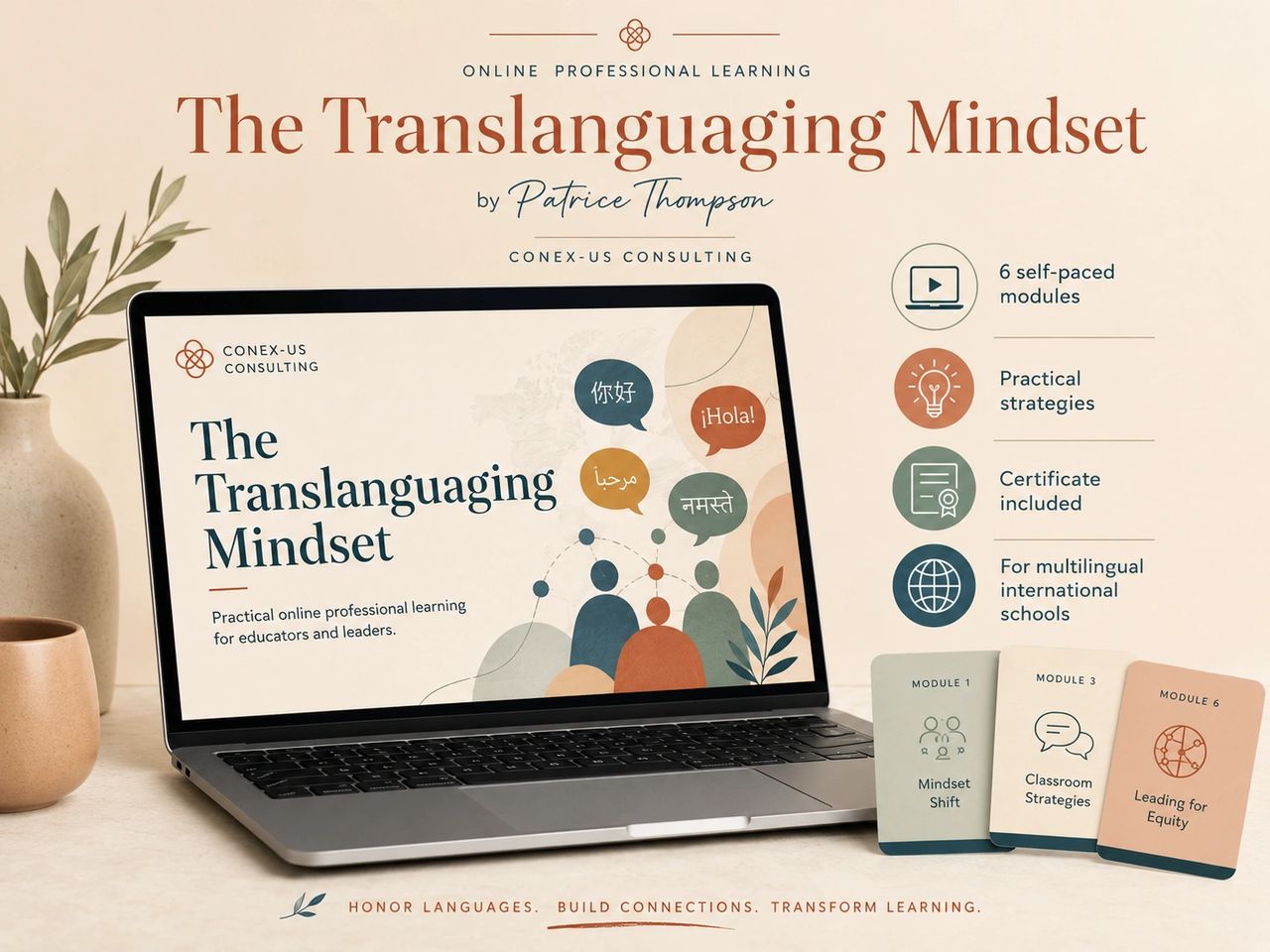
I created The Translanguaging Mindset for educators who want to make their classrooms more linguistically inclusive but aren’t sure where to begin.
It is a self-paced online translanguaging course built around six short modules and approximately 3.5 hours of professional learning.
The course moves from understanding multilingualism and translanguaging into practical classroom application, helping you notice where language can support learning throughout the school day.
Rather than asking you to collect a huge list of isolated strategies, the goal is to help you develop a lens you can use again and again:
Where could a student’s existing linguistic knowledge help them access this learning?
Once you start asking that question, opportunities appear everywhere.
During math.
During science.
During writing.
During class discussions.
During inquiry.
During assessment.
And gradually, translanguaging becomes less like an additional teaching strategy and more like part of how you design learning for multilingual students.
What You’ll Learn
Inside The Translanguaging Mindset, you’ll explore how to:
- understand translanguaging as a pedagogical approach
- recognize the linguistic resources multilingual learners already bring to school
- create opportunities for multilingual processing and meaning-making
- support connections and transfer across languages
- use students’ linguistic and cultural knowledge as part of academic learning
- make language inclusion possible even when you do not speak your students’ languages
- begin building more linguistically inclusive classroom practice
The course also includes reflection opportunities, practical examples, a professional learning certificate, and my Walk the Talk resource to help you continue putting the ideas into practice.
Explore The Translanguaging Mindset
Not Ready for a Full Course Yet?
You don’t have to start with professional development.
You can start with one lesson.
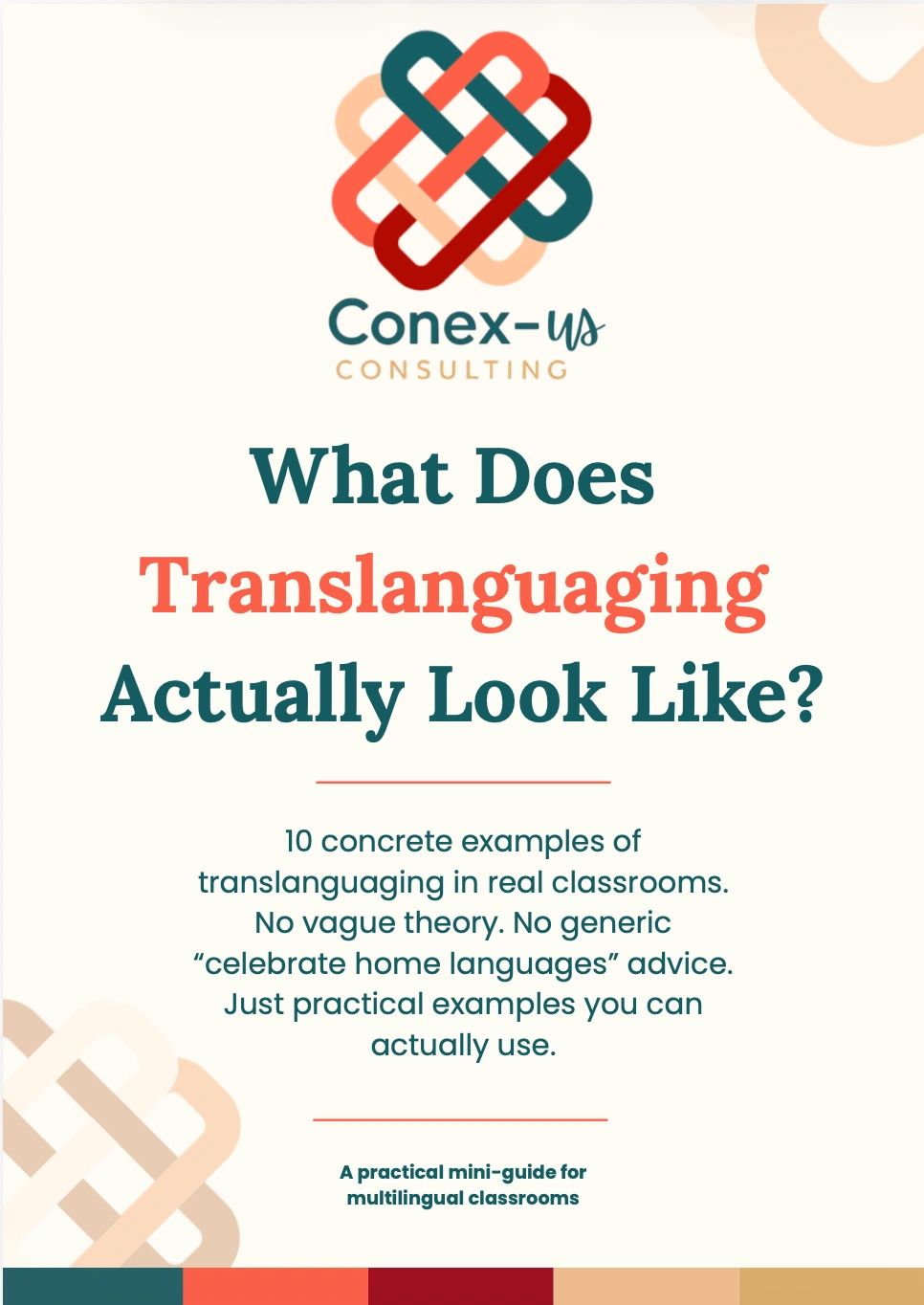
I’ve created a free Translanguaging Starter Kit with 10 practical examples of ways teachers can begin using students’ languages as resources for learning.
Try one, notice what happens, then build from there.
Translanguaging Is a Change in What We Notice
Teachers don’t need to become experts in every language represented in their classrooms.
We do, however, need to stop treating the school language as though it is the only language students should use for learning.
Multilingual learners arrive with enormous amounts of linguistic, cultural, and academic knowledge already available to them.
Translanguaging just gives us a way to use it.
And sometimes the first step is remarkably small:
Notice where language could become a tool for learning… and open the door.
Responses