3 Practical Translanguaging Examples for the Classroom


A lot of people think that translanguaging in the classroom must be complicated. It isn’t.
At least, not necessarily.
A lot of the time, it looks like making one small shift in a lesson so students can use the languages they already know to understand something better.
… And that’s it!
No twelve-language worksheet or frantic last-minute powerpoint translation. And really, please don’t think that you, as a teacher, need to suddenly become fluent in Korean by Tuesday.
The bigger shift is learning to notice where languages can help students access what they already know, make stronger connections, and show what they actually understand.
Here are three simple translanguaging examples in the classroom you can use to start thinking differently about language in a multilingual classroom.
Below are three examples. If you want more, download my free guide with 10 practical translanguaging examples for the classroom: 10 practical translanguaging examples for the classroom

1. Use Language and Culture to Activate Prior Knowledge
Imagine you’re introducing fractions.
Before drawing circles on a worksheet and dividing them into equal parts, you could ask students: “What is something people divide or share in your culture?”
Now you’ve opened a completely different door into the mathematics.
One of my favorite examples comes from Morocco. In this culture, couscous is traditionally eaten communally from one large round dish in the middle of the table. Everyone eats from the section directly in front of them.
There are no lines drawn across the plate and nobody measures it out, but everyone understands that the dish has invisible sections, and if you start reaching across and eating from somebody else’s “slice”… you are very much in the wrong part of the plate. 😅
That is already a way of understanding parts of a whole.
Another student might think about how food is shared at home, how something is divided during a celebration, how land or objects are partitioned, or another everyday practice from their own cultural experience.
Looking at it this way, fractions aren’t beginning as an abstract school concept. They connect to something students already understand.
And this is an important part of translanguaging pedagogy that can get lost when we think only about translating vocabulary.
Multilingual students bring more than multiple words for things. They bring multiple networks of experience, language, culture, and prior knowledge that can help them make sense of new learning.
Our job is sometimes as simple as reminding them to use them.
2. Use Languages to Make Connections Visible
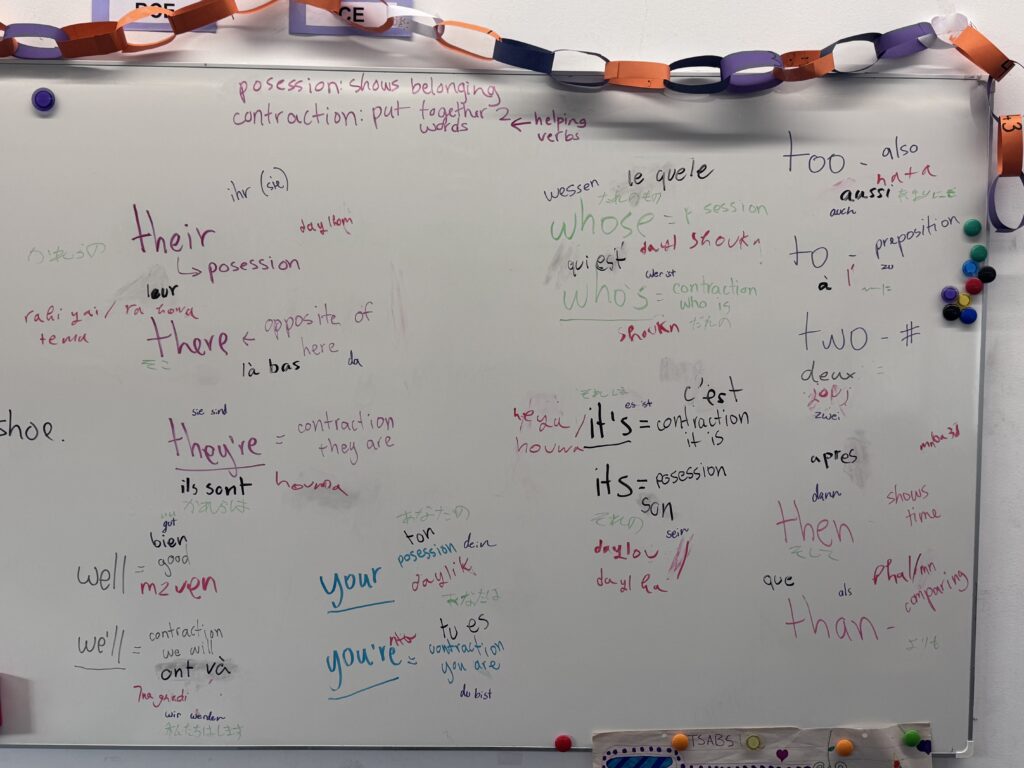
As a language nerd, vocabulary inquiry is one of my favorite ways to do language inclusion, because multilingual students are sitting on a ridiculous amount of linguistic information… but they often don’t realize it.
Multilingual classrooms with lots of languages can be so fun. When we come across a new word, a teacher can use home languages in a vocabulary inquiry by asking: “Does anyone recognize this word (or part of it) in another language?”
In a multilingual classroom, we might not just have a Spanish speaker making connections to English… we might also have the French and Italian speakers making connections with the Spanish speaker.
A Mandarin speaker might also recognize a character or pronunciation that connects in with Japanese or Korean.
So in addition to the new word’s discovery, students start comparing words across their own languages: noticing roots, cognates, and false friends. They might ask each other, “Wait, what do you call this?”
And then vocabulary is not something the teacher hands down from the front of the room; it becomes an authentic inquiry experience — and THEY are the experts.
What I find especially interesting is that students frequently do not think to make these connections unless we remind them that they can.
Their languages may have been kept so separate at school that it never occurs to them that something they know in one language might help them understand another.
But once students start looking across languages, they begin noticing patterns everywhere.
That kind of noticing builds much more than vocabulary.
It develops metalinguistic awareness: an understanding of how language itself works.
There is something delightful about watching a group of multilingual kids realize that their languages are connected in ways they had never thought about before.
3. Read in One Language. Think and Write in Another.
Here is another very easy one.
A student is expected to analyze a complex topic in English.
That does not mean every source they use needs to be in English too.
A fluent English-speaking student might read an article in Spanish or another home language, and write an analysis in English, or read a novel in German and discuss its themes in English.
They might watch a video explanation in Arabic, take notes using both Arabic and English, and then complete the final assignment in English.
Why?
Because multilingual students do not store all of their understanding in one language.
Different languages may give them access to different vocabulary, experiences, perspectives, sources, and prior knowledge.
The input language and the output language do not have to be identical.
And this is not just a strategy for students who are still developing proficiency in the language of instruction.
A student can be completely fluent in English and still find that another language gives them a different (or sometimes a better) route into an idea.
Let them use the linguistic resources that help them understand the idea deeply. Then, ask them to communicate that understanding in the language required for the task.
Language is a tool for learning. Why would we deliberately remove half the toolbox?
None of These Are Particularly Complicated
And that is kind of the point. Translanguaging does not have to begin with a complete redesign of your curriculum, or with a giant list of translanguaging strategies.
It can begin with a question: What linguistic resources do my students already have that could help them with this learning?
Sometimes the answer is activating cultural prior knowledge. Sometimes it is comparing vocabulary across languages. Sometimes it is allowing students to access information in one language and communicate their learning in another.
Those are simple shifts.
What takes longer is learning to notice the possibilities.
I speak six languages so you don’t have to. A lot of what I teach in The Translanguaging Mindset comes from years of noticing what happens when languages interact: where concepts connect, where they don’t, what multilingual students may already know, and the surprisingly simple opportunities teachers can create once they know what to look for.
If these three examples made you think, “Ohhh. I could do that,” I’ve put together 10 practical translanguaging examples for the classroom in a free guide.
Explore The Translanguaging Mindset
Because translanguaging is about learning to see multilingualism differently. And once you start seeing it, you’ll start finding opportunities everywhere.
Responses