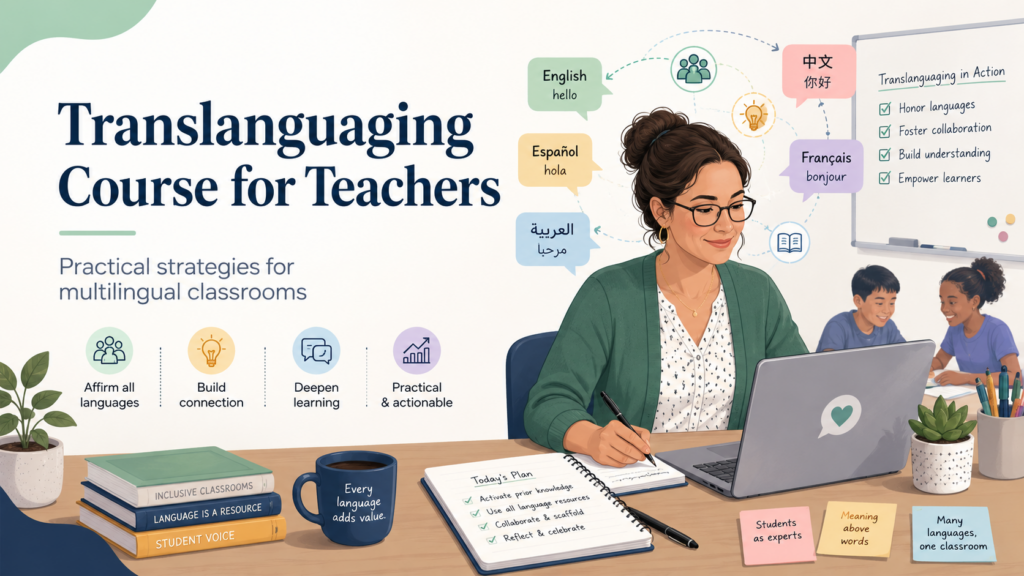
Translanguaging Strategies for the Classroom: Using Students’ Full Linguistic Repertoires Purposefully

Translanguaging Strategies for the Classroom: Using Students’ Full Linguistic Repertoires Purposefully
If you search for translanguaging strategies, you’ll find plenty of suggestions:
Let students discuss in their home language.
Use bilingual glossaries.
Compare vocabulary across languages.
Have students brainstorm in one language before writing in another.
Those can all be useful strategies.
But there is a bigger question I think we need to ask first:
What is the language actually doing for the learning?
Because translanguaging is not simply allowing students to use another language in class. Rather, it’s about recognizing that multilingual students already have a full linguistic repertoire that they use to think, interpret, connect, remember, question, and make meaning.
A multilingual student does not suddenly stop knowing what they know because the language of instruction changes. So instead of asking: “How can I add students’ home languages into this lesson?” I find it more useful to ask:
Where could students’ full linguistic repertoires help them learn more deeply?
That mindset switch gives us a much clearer way to think about translanguaging strategies.
1. Use translanguaging to access what students already know
Imagine you are beginning a unit on ecosystems.
Before introducing new terminology in English, you ask students to think about what they already know about the relationships between plants, animals, climate, and the environment.
For a multilingual student, some of that knowledge may have been developed in Arabic. Or Korean. Or Spanish. Or French.
That knowledge does not need to be recreated from scratch in English.
Students might:
- discuss prior knowledge with a partner using whichever language helps them think most precisely
- annotate a diagram using words from more than one language
- search for information in another language before returning to an English-language resource
- connect a new English term to a concept they already understand through another language
The purpose here is not translation for translation’s sake. That’s performative, and we want to move away from it.
The purpose is access — and not necessarily to make sure that students understand the English. They might already understand it very well.
But here, you are helping students make connections between new learning and knowledge that already exists.
This is one reason translanguaging can be especially powerful at the beginning of a lesson or unit. Before asking students to learn something new, we encourage them to access everything they already bring with them.
2. Use translanguaging for processing
This is probably one of the easiest places to begin.
Students do not need to do all of their thinking in the same language in which they will eventually produce their work.
Suppose students have just read a difficult passage in English.
Before answering a question, they might:
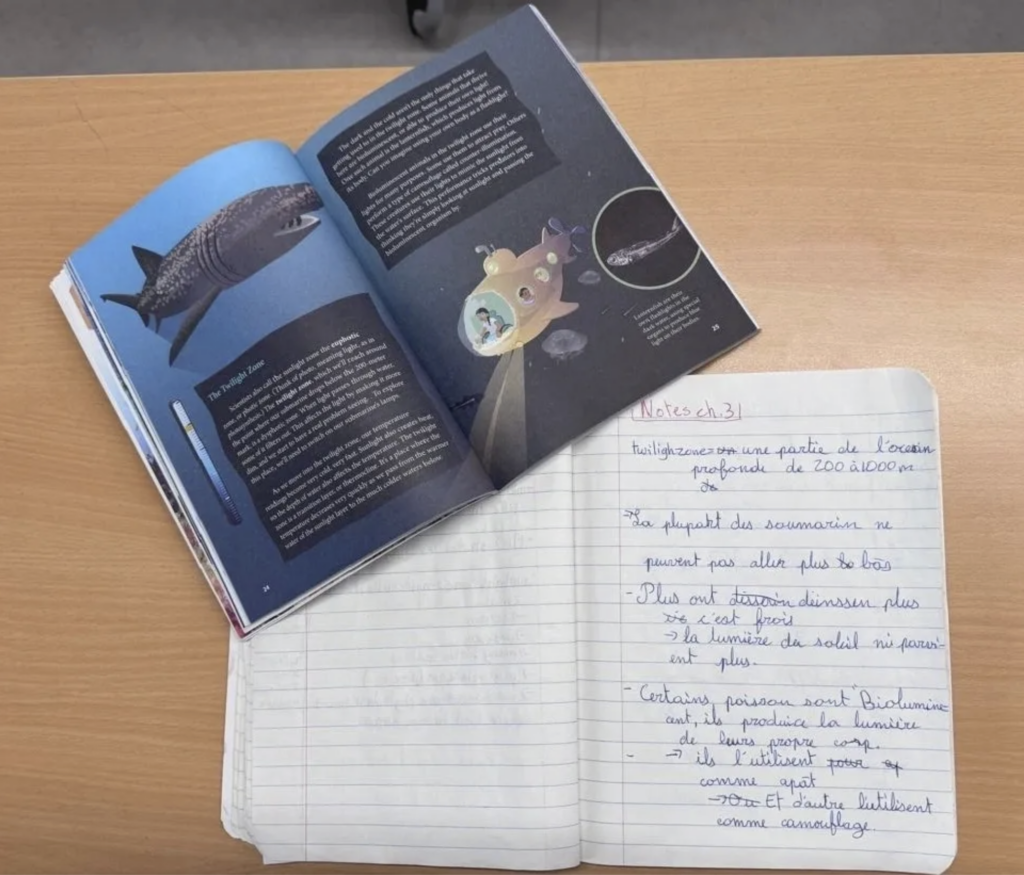
- turn to a multilingual partner and discuss the idea using both languages
- jot notes to themselves in whichever language comes most naturally
- explain the concept aloud in their home language before reformulating it in English
- compare how the idea would be expressed across languages
- use another language to clarify a confusing part of the text
The final response may still be in English.
But the thinking process does not have to be. That distinction is important.
Sometimes we unintentionally assess students’ ability to process complex ideas in English at the exact moment we are trying to teach them the ideas themselves. Those are not always the same thing.
Allowing multilingual processing gives students more ways into the learning before we ask them to communicate it in the language required by the task.
Want more practical ways to make multilingualism visible in everyday learning?
Download my free guide to translanguaging in the classroom for strategies you can start using right away.
3. Use translanguaging to strengthen language and conceptual connections
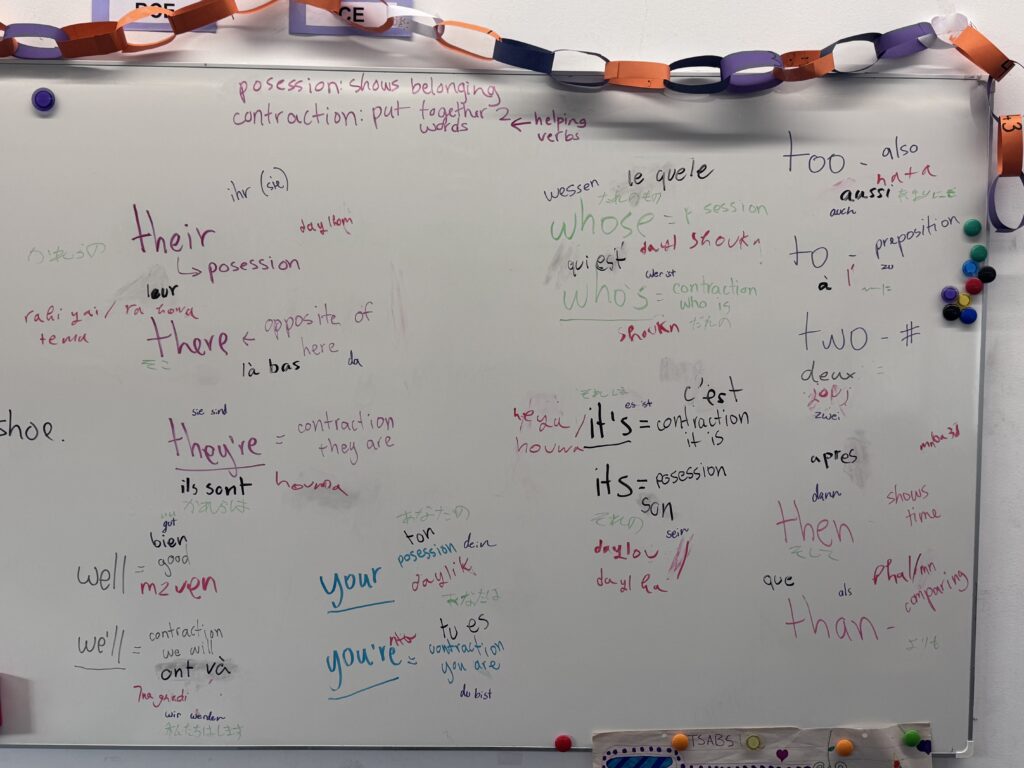
Multilingual students constantly carry linguistic knowledge from one language into another. We can make those connections visible.
For example, students might compare:
- cognates
- prefixes and suffixes
- sentence structures
- idioms
- word origins
- grammatical patterns
- ways different languages organize or express the same idea
You don’t have to speak all of your students’ languages to do this. In fact, students can often become the experts. If that still feels like the biggest obstacle, I wrote a whole piece on how to use translanguaging when you don’t speak your students’ languages.
You might ask:
Does this new word remind you of anything in another language you know?
How would you express this idea at home?
Is the sentence structured the same way in both languages?
Is there a word in another language that captures this idea particularly well?
Sometimes the answer will be yes.
Sometimes students will tell you the languages work completely differently.
And sometimes… they might not know the answer, because they haven’t thought about that before in their home language.
All of these cases are interesting.
That conversation helps students develop awareness of how language works, while also positioning multilingualism as intellectual knowledge rather than something students should leave outside the classroom.
Research on pedagogical translanguaging frequently highlights this kind of cross-linguistic and metalinguistic awareness as one of its important possibilities. A 2026 systematic review of 160 studies, for example, identified using the full linguistic repertoire and developing metalinguistic awareness as recurring forms of pedagogical translanguaging.
4. Use translanguaging before asking students to produce in English
One of the misconceptions I hear about translanguaging is that it means students no longer need to develop English.
It doesn’t.
There are many situations where the final product should still be in English.
The question is whether every step leading to that product also needs to happen exclusively in English.
Imagine a student preparing an analytical paragraph.
They might:
- discuss their interpretation with a classmate in Spanish
- write notes using Spanish and English
- identify the English academic vocabulary they will need
- draft the final paragraph in English
The learning goal has not disappeared.
Neither has the English.
What has changed is that the student was encouraged to use more of their cognitive and linguistic resources while getting there.
That can be especially useful when we want students to demonstrate sophisticated thinking rather than simply demonstrate how much thinking they can currently express spontaneously in English.
5. Use multilingual resources, not just multilingual conversation
Translanguaging does not have to mean students constantly speaking different languages to one another.
It can also mean expanding the resources they habitually use.
Students might:
- read an article about the topic in another language
- watch an explanatory video in a language they know well
- use multilingual dictionaries or glossaries
- compare English-language information with resources from another linguistic context
- interview a family member
- draw on books or media from home
- use digital tools to help move between languages
This becomes particularly powerful when the multilingual resource adds something to the learning rather than simply duplicating the English version.
A student researching a historical event, for example, may encounter different perspectives depending on the language of the source.
Now multilingualism is doing more than supporting comprehension.
It is actually expanding the knowledge available in the classroom.
6. Use translanguaging to make students’ thinking visible
Sometimes teachers worry:
But how will I know what students are doing if I don’t understand the language?
That is certainly a reasonable question.
But we already teach students whose thinking we cannot directly observe.
The solution is not to restrict the thinking.
It is to build ways for students to make that thinking visible.
A student might discuss an idea in Mandarin and then:
- give you the conclusion in English
- show you a diagram
- explain which evidence they selected
- write a short English summary
- teach you an important word they used
- compare their group’s thinking with another group
You do not have to understand every sentence students produce in order to understand whether learning is happening.
Importantly: over time, multilingual classrooms develop routines.
Teachers learn what productive collaboration looks like. Students learn that using another language is not an invitation to disappear from the lesson. Everyone becomes more comfortable with linguistic flexibility.
The strategy is not the point
This is where I think conversations about translanguaging sometimes get stuck.
We collect strategies.
Bilingual word walls. Partner talk. Multilingual notes. Translation tools.
And those things can absolutely be useful.
But the strategy itself is not what makes a classroom translanguaging-friendly.
The deeper shift is recognizing that multilingual students do not arrive in our classrooms with several separate linguistic boxes, one of which happens to contain the language of instruction.
They arrive with a repertoire.
Research increasingly supports the idea that translanguaging can support sense-making, collaboration, engagement, identity, and belonging for multilingual learners, although the way it works depends heavily on context. A 2025 systematic review of 111 PK–12 studies found translanguaging being used both naturally and deliberately as students made meaning across languages and participated in learning.
So instead of asking:
What translanguaging activity should I do tomorrow?
Try asking:
Where in tomorrow’s lesson might students benefit from using everything they know?
Maybe it is when they activate prior knowledge.
Maybe it is while they wrestle with a difficult concept.
Maybe it is while they plan their writing.
Maybe it is when they notice a connection between languages that you never would have seen yourself.
That is where translanguaging becomes much more than another classroom strategy.
It becomes part of how we design learning for multilingual students.
If your school is trying to move from valuing multilingualism in principle to making it visible across classrooms, leadership, and the wider school community, that’s the work I do through Conex-Us Consulting.
Explore how I work with multilingual schools
Keep exploring:
3 Practical Translanguaging Examples for the Classroom
Translanguaging When You Don’t Speak Your Students’ Languages.
Already thinking about how this could look across your school?
Book a free consultation.

Responses