Translanguaging vs. Code-Switching: What’s the Difference?

A student is explaining something to a classmate in English. Halfway through the explanation, she switches to Arabic, clarifies her point, and then returns to English.
What just happened?
Was that code-switching? Translanguaging? Both?
If you’ve been exploring multilingual education, you’ve probably encountered both terms. They’re often used in discussions about multilingual classrooms, and sometimes they’re used almost interchangeably.
But they aren’t quite the same thing.
And understanding the distinction can change how we think about language in the classroom.
What is code-switching?
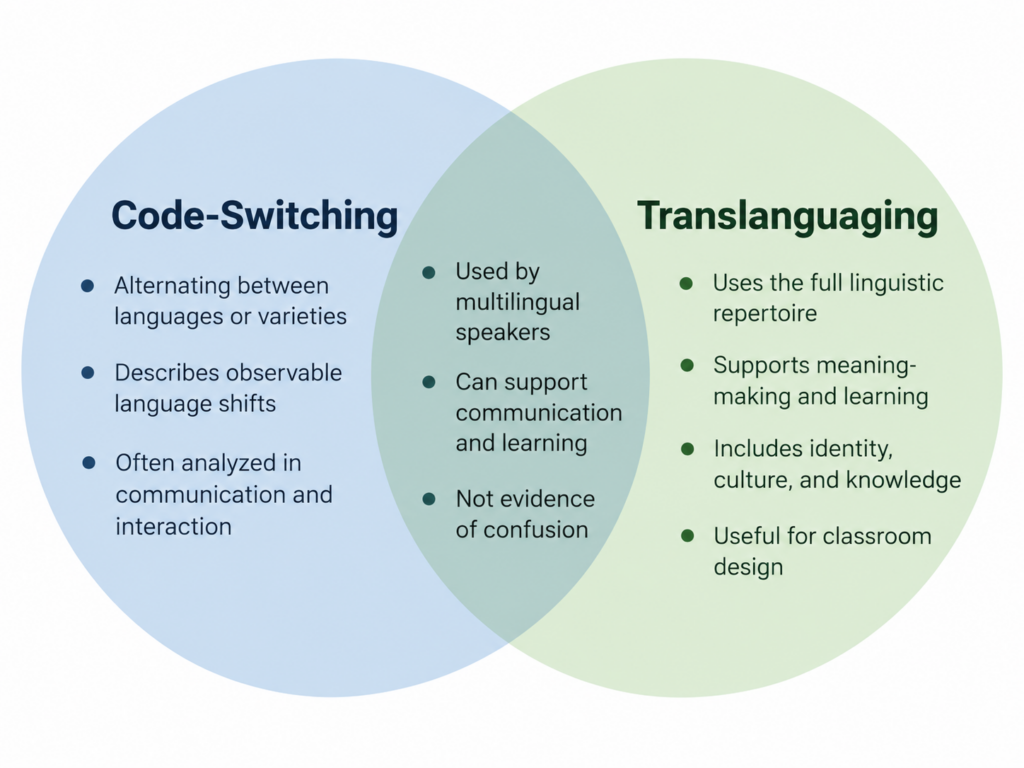
Code-switching generally refers to alternating between languages or language varieties during communication.
A multilingual speaker might begin a sentence in English, insert a phrase in Spanish, and finish in English. Or they might use one language with a teacher and another with a classmate.
Code-switching research examines these patterns and their linguistic and social functions.
For example, a student might say:
“I finished the assignment, pero no entiendo la última pregunta.”
The speaker has moved between English and Spanish within the same utterance.
But code-switching isn’t random, and it certainly isn’t evidence that the speaker is confused. Researchers have documented the complex linguistic and social patterns involved in multilingual language use.
What is translanguaging?
Translanguaging approaches multilingual communication from a somewhat different perspective.
Rather than focusing primarily on when a speaker moves between named languages, translanguaging examines how multilingual people draw on their linguistic resources to communicate, think, learn, and make meaning.
This can include practices that we might describe as code-switching, but translanguaging also invites us to consider a much broader range of meaning-making processes.
Imagine a student learning about climate change. She reads a text in English, discusses the ideas with her partner in Arabic, recalls something her grandfather explained about changing rainfall patterns, sketches a diagram, and then writes her response in English.
There might be code-switching during that process.
But the learning involves much more than switching between languages.
She’s drawing on her linguistic resources, prior experiences, cultural knowledge, and different forms of expression to construct understanding.
That’s the kind of learning process a translanguaging perspective helps us recognize.
So what’s the actual difference?
Here’s a useful starting point:
Code-switching helps us describe patterns of language alternation. Translanguaging offers a broader perspective on multilingual meaning-making.
That doesn’t mean code-switching research ignores meaning, identity, or social context. Quite the opposite. Scholars have studied those dimensions for decades.
And it doesn’t mean every researcher agrees about how translanguaging and code-switching relate to one another.
Some scholars conceptualize multilingual speakers as drawing on a single integrated linguistic repertoire, while others emphasize the continuing significance of distinguishable linguistic systems.
These are important theoretical discussions, but teachers don’t need to resolve every debate before making instructional decisions.
For classroom practice, I think there’s a more useful question.
What does this distinction mean for teachers?
Imagine you’re teaching a lesson on ecosystems.
Two students begin discussing food chains in Mandarin before preparing an English explanation.
If we’re simply watching for code-switching, we might notice that the students changed languages.
But if we’re looking through a translanguaging lens, we can ask additional questions.
What are the students doing with their languages?
Are they clarifying a concept? Connecting new vocabulary to something they already know? Testing an explanation? Building confidence before sharing their thinking?
And, perhaps most importantly, does our classroom design make room for those processes?
A teacher doesn’t need to speak Mandarin to recognize that this discussion could be supporting the students’ learning.
The teacher can provide the academic goals, model the necessary disciplinary language, invite students to use relevant linguistic resources, and assess their understanding.
The goal isn’t to replace English instruction. It’s to ensure that English isn’t the only resource students are permitted to use while learning.
For more ideas, explore these practical translanguaging examples for the classroom.
From noticing language to designing for it
This is where I think the distinction becomes particularly valuable.
We can spend a lot of time identifying what multilingual students are doing with their languages.
But what happens when teachers deliberately design learning experiences that make productive use of those resources?
What changes when students are invited to make connections across languages, process complex ideas using their full repertoires, and bring their cultural knowledge into classroom discussions?
We move from observing multilingualism… to designing for it.
And that’s not only an important difference, but it’s also a mindset shift.
Because multilingual students don’t become multilingual only when they switch languages.
They bring their linguistic resources, knowledge, and experiences into the classroom every day.
Our responsibility is to design learning environments that recognize and make room for them.
Want to explore how to make that shift in your own teaching? My self-paced course, The Translanguaging Mindset, helps educators develop a more intentional approach to multilingual learning.

Responses