
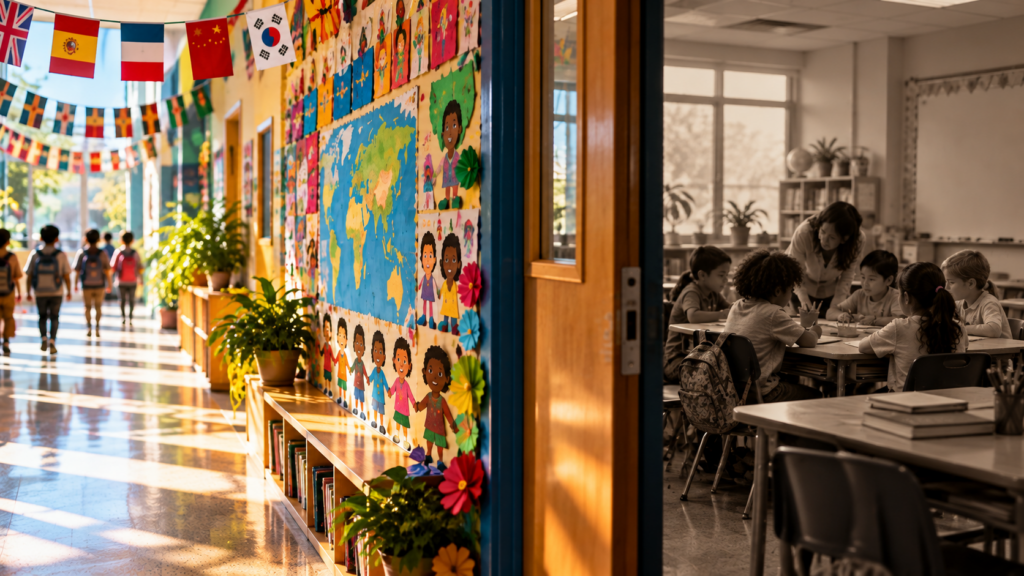
Schools love celebrating diversity.
We display flags from around the world, organize international days, invite families to share their traditions, and proudly describe our communities as multicultural and multilingual.
But what happens when we ask students whether those languages should actually be used for learning?
A few years ago, I asked 71 Grade 4 students at a multilingual school in China a series of questions about their languages, cultures, and experiences at school.
This was part of a broader effort to introduce translanguaging into the school’s teaching practices, which I later documented in a co-authored case study with Paul Magnuson.
Their answers revealed a fascinating contradiction.
Students valued multilingualism. But many didn’t believe it belonged in the classroom.

62% of students supported English-only at school
One of my survey statements was:
“We should all just speak English only at school.”
Of the 71 students surveyed, 45 agreed or strongly agreed.
That’s approximately 63% of the students.
And yet, when asked whether using their home language was good for their brains, 54 students, or 76%, agreed.
Another 61 students, or 86%, agreed that their home culture was valuable and that they wanted to share it with others.
Think about that for a moment. Most students recognized the value of their own linguistic and cultural backgrounds. Yet most also believed English should be the only language spoken at school.
How can both things be true?
The invisible language hierarchy
The open-ended responses were particularly revealing.
One student explained: “No because school is for learning English so maybe can speak home language in home.”
Another wrote: “When it is play time, I say my home language, but I say English in class! 🎀” (ribbon emoji included)
And another was concerned that classmates might feel uncomfortable hearing languages they didn’t understand.
These responses weren’t necessarily expressions of hostility toward other languages. They reflected assumptions about where those languages belonged.
English was the language of school. Other languages were for home, family, and sometimes the playground.
This is an example of an internalized linguistic hierarchy: the idea that certain languages have greater legitimacy, authority, or value in particular settings.
Students can develop these assumptions without anyone explicitly telling them that their home languages are inferior.
They learn from the language of instruction, the materials displayed in classrooms, the rules governing participation, the responses they receive from adults, and the languages associated with academic success.
When English is consistently positioned as the language of knowledge, students may begin to associate academic legitimacy with English itself.
Celebrating diversity isn’t the same as creating linguistic equity
Here’s another finding from the survey.
When asked whether they felt interested and happy when other students spoke languages they didn’t understand, 30 of 71 students, or 42%, disagreed or strongly disagreed.
Meanwhile, most students expressed curiosity about learning about their classmates’ cultures and languages.
In other words, students could be enthusiastic about cultural diversity in principle while feeling less comfortable encountering linguistic diversity in practice.
This distinction is important.
A school can have dozens of nationalities represented in its student population, celebrate international-mindedness, and still operate within a largely monolingual academic culture.
In fact, this is quite common in English-medium international education.
Multilingualism may be celebrated as part of students’ identities while being excluded from the actual processes of teaching and learning.
The message becomes: Your language is wonderful. Just don’t use it during the lesson.
What translanguaging changes
Translanguaging pedagogy offers an opportunity to challenge these assumptions.
When students are encouraged to draw on their linguistic repertoires to process information, make connections, collaborate, and demonstrate understanding, their languages become visible as academic resources.
Picture a student explaining a mathematical concept in Mandarin before presenting the reasoning in English.
Or a group of students comparing how a scientific idea is expressed across Arabic, French, and English.
Or a class learning something new from a student who has access to a source in a language the teacher doesn’t speak.
These experiences can change who is recognized as knowledgeable in the classroom.
They also create opportunities for students to reconsider their assumptions about which languages belong in academic spaces.
And this is important for monolingual students, too.
A classroom that recognizes linguistic diversity can help all students develop more nuanced understandings of language, identity, knowledge, and power.
What should we actually be measuring?
We often evaluate multilingual education through academic achievement, language proficiency, or teacher implementation.
Those are useful measures. But what about the classroom culture itself?
At Conex-Us Consulting, this is at the heart of our work. We help schools move beyond celebrating linguistic diversity to intentionally creating environments where students’ languages are recognized, valued, and used as resources for learning.
That means looking beyond what teachers are doing, to consider what students are experiencing.
Do students see their languages as legitimate resources for learning?
Do they feel comfortable hearing languages they don’t understand?
Do they recognize their multilingual classmates as knowledgeable contributors?
Are their assumptions about the relative value of different languages changing?
And are schools creating meaningful opportunities for students to use their linguistic resources beyond cultural celebrations?
These are the kinds of questions that guide our work with schools, because implementing translanguaging is about more than introducing instructional strategies.
It’s about changing the linguistic culture of a classroom, and ultimately, the school itself.
Because a school may improve students’ English while doing very little to challenge the idea that English is inherently more valuable than their other languages. Those are different educational outcomes.
From good intentions to meaningful change
My original Grade 4 survey was an informal classroom inquiry, not a validated research instrument.
I also never conducted the follow-up survey at the end of the year, so I can’t claim that the subsequent classroom work changed students’ attitudes.
But the baseline findings stayed with me.
They revealed something that I might otherwise have missed: students who valued their languages and cultures could still believed those languages didn’t belong in school.
And that realization influenced how I approached translanguaging.
The goal was never to make students use multiple languages in every lesson.
It was to create an environment in which students recognized their own linguistic resources, and those of their classmates, as valuable contributions to learning.
Because multilingual education is about more than acquiring another language.
It’s also about the relationships students develop with their own identities, with one another, and with the languages that surround them.
If we want students to emerge from our classrooms with a more egalitarian understanding of language, we need to pay attention to the hierarchies they bring into them, and the ones our schools may unintentionally reinforce.
And perhaps it’s time we started measuring that, too.
What would your students say about the languages in their classroom?
At Conex-Us Consulting, we help international and bilingual schools examine the gap between their commitment to multilingualism and students’ everyday experiences, then turn those insights into meaningful classroom practice.
If your school is ready to move beyond celebrating linguistic diversity toward designing for it, explore how we can work together.
Patrice Thompson, M.Ed., MBA, is the founder of Conex-Us Consulting, supporting schools in moving from valuing multilingualism to designing for it through translanguaging pedagogy and school-wide implementation.
Next steps: see how school-wide language inclusion support works; or book a free discovery call to talk through your school’s context.
Related reading: English-Only Rules at School: Why Language Inclusion Is a Leadership Decision | How Can a School Become More Language-Inclusive? | If Translanguaging Is Common Sense, Why Isn’t It Common Practice?