
Why developing proficiency in two languages doesn’t have to mean keeping them apart.
Dual-language programs are designed to do something that many mainstream classrooms still struggle to accomplish: recognize bilingualism as an educational goal rather than an obstacle to overcome.
Students learn academic content through two languages. They develop literacy, build relationships across linguistic communities, and have opportunities to use languages that might otherwise be marginalized in school.
So far, so good.
But there’s an interesting contradiction at the heart of many dual-language programs.

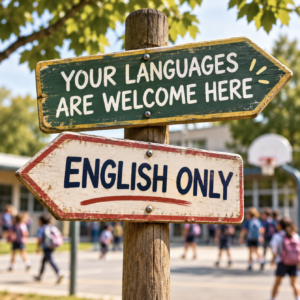
We want students to become bilingual, yet we sometimes insist that they learn as though they were monolingual.
English in one block. Spanish in another. Or Mandarin, French, Arabic, or whichever partner language the program offers.
The languages are assigned their places, and students are expected to keep them there.
But is that really how bilingualism works?
The logic behind language separation
To understand this debate, we first need to recognize why dual-language programs separate languages in the first place.
Language allocation models, including 50/50 and 90/10 approaches, are intended to provide sustained opportunities for students to develop proficiency in both instructional languages.
And there’s a particularly important equity consideration.
In communities where English dominates public life, media, and institutional communication, schools may be among the few places where children have sustained opportunities to use a minoritized language for academic learning.
Without deliberate protections, English can easily become the default.
So the concern that allowing translanguaging might undermine development of the partner language isn’t unreasonable.
The goal of protecting space for minoritized languages is important. But does protecting a language require separating it from everything students already know?
That’s where the conversation becomes more complicated.
The problem with treating bilingualism as two monolingualisms
Bilingual people don’t simply possess two separate linguistic systems that they activate independently of one another.
Their knowledge, experiences, and linguistic resources interact.
A student learning about ecosystems in Spanish doesn’t suddenly lose everything they’ve previously learned about ecosystems in English.
A child who encounters a scientific concept in Mandarin may draw on ideas, vocabulary, and experiences developed through another language to make sense of it.
And when students move between languages to explore meaning, clarify ideas, or make connections, they aren’t necessarily demonstrating confusion.
They’re drawing on their linguistic repertoires.
This is central to translanguaging: understanding and leveraging the ways multilingual people draw on their linguistic resources to construct meaning, communicate, and learn.
But in some dual-language settings, those practices can conflict with expectations that each language must remain within its designated instructional space.
The result is a curious situation.
A program designed to develop bilingual learners may end up treating the very practices associated with bilingualism as something to discourage.
If you’re wondering what it means to draw on students’ full linguistic repertoires, I’ve explored the distinction between translanguaging and translation here.
What does the research say?
This tension isn’t new.
In a 2014 study, Deborah Palmer and colleagues examined the practices of two experienced teachers in a Texas two-way dual-language school.
Their research challenged the assumption that strict language separation was necessary for effective bilingual instruction. The teachers drew on students’ dynamic bilingual practices in ways that informed classroom pedagogy and supported their bilingual identities.
The study raised an important question: What opportunities might be lost when bilingual students are expected to operate within rigid linguistic boundaries?
Similarly, Sánchez, García, and Solorza (2018) challenged traditional language allocation policies in dual-language education, arguing for approaches that better recognize students’ existing bilingual practices.
More recently, Hamman-Ortiz (2024) explored the creation of critical translanguaging spaces within dual-language bilingual education, examining how bilingual practices intersect with language policies, identities, and power.
These studies don’t demonstrate that language allocation is unnecessary, or that unrestricted language mixing produces better academic outcomes in every context.
What they do suggest is that the relationship between translanguaging and dual-language education is more complex than a choice between separating languages and allowing students to use whichever language they prefer.
And that’s a distinction worth taking seriously.
But what about protecting the partner language?
This is perhaps the most important question in the debate.
If students can use English whenever they encounter difficulty, will they still develop the academic proficiency they need in Spanish, Mandarin, or another partner language?
This concern is closely related to a question I hear frequently: does allowing translanguaging slow English development?
That concern deserves more than a dismissive response.
Translanguaging shouldn’t become an excuse for abandoning explicit language-development goals, reducing opportunities to engage with the partner language, or allowing the socially dominant language to take over.
In fact, research on Mandarin-English dual-language education has highlighted precisely this tension: the need to create opportunities for translanguaging while maintaining meaningful instructional space for Mandarin in an English-dominant society.
But there’s an important distinction between protecting opportunities to develop a language and requiring students to suppress their other linguistic resources during learning.
Those aren’t necessarily the same thing.
Dual-language programs can maintain ambitious goals for proficiency and biliteracy while critically examining whether every language boundary serves those goals.
The question isn’t whether language development should be intentional.
Of course it should.
The question is what that intentionality actually looks like when we’re teaching bilingual children.
From language separation to intentional language design
Perhaps we need to reconsider the question we’re asking.
Instead of asking, “How do we make sure students keep their languages separate?” we might ask:
“How do we design learning that develops both languages while recognizing the linguistic resources students already possess?”
That shift changes the conversation.
It moves us away from treating translanguaging as something teachers either permit or prohibit, and toward considering its relationship with curriculum, academic language development, identity, and equitable participation.
It also demands thoughtful professional learning.
Because reconciling translanguaging with the goals of dual-language education isn’t simply a matter of telling teachers to let students use both languages.
It requires a shared understanding of bilingualism, the purposes behind instructional language decisions, and the learning experiences schools want to create.
Those decisions deserve to be grounded in research rather than inherited assumptions about how languages should function in classrooms.
The same principle applies across multilingual classrooms: the question isn’t simply which languages students use, but how their linguistic resources contribute to learning.
Are we designing for bilingual learners?
Dual-language education represents an important commitment to multilingualism.
But the existence of two instructional languages doesn’t automatically mean that a program is designed around how multilingual people actually learn.
We need to look beyond the language allocation timetable and examine the assumptions shaping the student experience.
Are students being encouraged to make meaningful connections across their linguistic knowledge?
Are their multilingual identities recognized as part of academic learning?
And are our instructional choices helping students develop as bilingual thinkers, learners, and communicators?
Because ultimately, a dual-language program should be more than two monolingual programs sharing a timetable.
And this raises a wider question for school leaders: how can language inclusion become a consistent part of school culture rather than an isolated classroom practice?
The goal isn’t simply to teach two languages.
It’s to educate bilingual learners.
Moving from belief to design
At Conex-Us Consulting, I work with educators and school leaders to move beyond simply valuing multilingualism toward intentionally designing learning for multilingual students.
If you’re exploring how translanguaging fits within your school’s language policies, classroom practices, or professional learning priorities, I’d love to connect.
Explore professional learning with Conex-Us Consulting
References
Hamman-Ortiz, L. (2024). Cultivating a critical translanguaging space in dual language bilingual education. International Multilingual Research Journal, 18(2), 119–139. https://doi.org/10.1080/19313152.2023.2277101
Palmer, D. K., Martínez, R. A., Mateus, S. G., & Henderson, K. (2014). Reframing the debate on language separation: Toward a vision for translanguaging pedagogies in the dual language classroom. The Modern Language Journal, 98(3), 757–772. https://doi.org/10.1111/modl.12121
Sánchez, M. T., García, O., & Solorza, C. (2018). Reframing language allocation policy in dual language bilingual education. Bilingual Research Journal, 41(1), 37–51. https://doi.org/10.1080/15235882.2017.1405098
Tian, Z., & Lau, S. M. C. (2023). Translanguaging pedagogies in a Mandarin-English dual language bilingual education classroom: Contextualised learning from teacher-researcher collaboration. International Journal of Bilingual Education and Bilingualism, 26(8), 960–974. https://doi.org/10.1080/13670050.2022.2161815
Next steps: try the free Starter Kit for ten examples you can use this week; take the Multilingual Classroom Checkup to see where your classroom stands; or explore the self-paced course The Translanguaging Mindset.
Related reading: Translanguaging vs. Code-Switching: What’s the Difference? | Your Students Love Multilingualism. So Why Do They Still Want English-Only Classrooms?