
Why what we know about multilingual learning doesn’t always make it into mainstream classrooms.
TL;DR: Many strategies associated with translanguaging have been used for decades, yet remain unfamiliar to mainstream teachers. Bridging the gap requires collaboration between language specialists and subject teachers, shared goals, and school-wide support.

A classroom full of multilingual learners
Last year, I observed a middle-school teacher whose classroom is almost entirely multilingual.
All but one of his students spoke more than one language at home, and many were still developing their English proficiency.
Yet his lessons were almost exclusively lecture-based. He doesn’t incorporate structured opportunities for students to talk through ideas with one another, even through something as straightforward as turn-and-talk.
Until recently, he hadn’t ever encountered language-inclusive teaching practices.
When I sat in his class, I immediately thought about all the opportunities for learning that could be created with a few changes to his approach.
Students could discuss complex concepts with their peers before responding to the teacher. They could draw on their home languages to process unfamiliar vocabulary, connect new information to prior knowledge, and develop their understanding before expressing it in English.
And the teacher wouldn’t need to speak any of those languages himself.
He would need to understand how students’ linguistic repertoires can support learning, and how to design opportunities for students to use them.
What I noticed the most wasn’t what this teacher wasn’t doing.
It was what he hadn’t yet had the opportunity to learn.
And it reminded me of something I’ve been thinking about for years.
For teachers encountering these ideas for the first time, it helps to see what a language-inclusive classroom actually looks like in everyday practice.
What seems obvious depends on where you’re standing
Before I became a homeroom teacher, my professional background was in language education.
I was a language person. I understood the value of cross-linguistic connections, translation, multilingual discussion, and helping students use what they already knew in one language to make sense of another.
These weren’t particularly revolutionary ideas to me.
But when I moved into homeroom teaching, I began noticing something almost immediately: language was everywhere in the curriculum, but it wasn’t always being considered in the teaching.
Students were expected to explain mathematical reasoning, interpret scientific texts, participate in discussions, and demonstrate conceptual understanding.
Yet the linguistic demands of those tasks were usually not addressed.
And opportunities for students to draw on the languages they already knew were often overlooked.
I began to realize that what felt like common sense to me, because of my background in language education and my experience as a language learner, wasn’t necessarily part of the pedagogical knowledge that other teachers had developed.
Not because those teachers were less capable or less committed to their students.
We had simply been trained to notice different things. A math teacher might focus on the progression of mathematical concepts and the development of reasoning. A language specialist might notice how vocabulary, sentence structures, and opportunities for discussion influence students’ ability to engage with those concepts.
Both perspectives are valuable… but when they remain separate, students can miss out on the benefits of bringing them together.
The expertise already exists. So where is the disconnect?
Language educators have used translation, bilingual scaffolding, and cross-linguistic comparisons for generations.
And research into multilingual education has continued to expand our understanding of how students draw on their linguistic resources to learn.
These ideas aren’t necessarily new.
But their familiarity within language education doesn’t mean they have become standard practice across the curriculum.
Consider how schools typically organize professional expertise.
Language teachers collaborate with other language teachers. EAL specialists attend professional development focused on language acquisition. Math and science teachers participate in subject-specific training.
There are good reasons for these arrangements. Teachers need opportunities to deepen their disciplinary expertise.
But they can also create silos.
And when expertise about language and learning stays largely within language departments, mainstream teachers may have fewer opportunities to develop that knowledge themselves.
This is particularly significant in international and multilingual schools, where students use language to construct understanding in every subject, every day.
Language isn’t something that happens only during English lessons or EAL support sessions.
It’s how students interpret instructions, make connections, formulate questions, collaborate with peers, and communicate their thinking.
Every teacher teaches through language, whether they recognize it or not.
So how do we make sure that knowledge about multilingual learning reaches every classroom?
This is why multilingual learners cannot be the responsibility of the EAL department alone. Specialist expertise is essential, but its impact depends on how it shapes teaching across the curriculum.
Collaboration can change what teachers notice
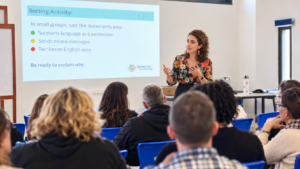
If, for example, a science teacher and a language specialist planning a unit together: the science teacher knows which concepts students need to understand, where common misconceptions arise, and what constitutes a strong scientific explanation. Meanwhile, the language specialist can help identify the linguistic demands of the unit, opportunities for collaborative meaning-making, and ways students might draw on their existing languages to deepen their understanding.
Together, they might design a lesson in which students first examine a concept through diagrams, discussion, and multilingual resources before developing explanations in English.
The scientific expectations haven’t changed.
The opportunities for students to access and demonstrate their understanding have.
And perhaps just as importantly, both teachers have learned something that can inform their future practice.
This is one of the things I find most exciting about cross-department collaboration.
It allows professional knowledge to move beyond the people who already possess it.
Instead of treating language-inclusive teaching as a specialist intervention, schools can begin developing a shared understanding of how language supports learning across the curriculum.
And we have examples of what this looks like in practice.
The CUNY-NYSIEB initiative documented schools that deliberately created time for collaboration between language specialists and mainstream teachers. In one participating school, ESL and classroom teachers had weekly planning sessions to differentiate instruction, develop scaffolds, and share effective practices. Teachers also collaborated across grade levels to monitor students’ language development alongside their academic progress.
This wasn’t collaboration left to chance. It was built into the school schedule.
And that’s an important distinction.
We can encourage teachers to collaborate all we want, but if we don’t give them the time, structures, and shared goals to do so, we’re leaving meaningful change dependent on individual initiative.
The goal is to make language development a shared responsibility, with teachers working together to identify what students need to understand, how language shapes that learning, and how they can support both content knowledge and language development.
Of course, shared understanding also needs to become classroom practice. That means knowing how to use translanguaging purposefully, rather than simply adding multilingual activities to existing lessons.
But collaboration alone isn’t enough
Of course, a few collaborative planning meetings won’t automatically transform a school’s approach to multilingual education.
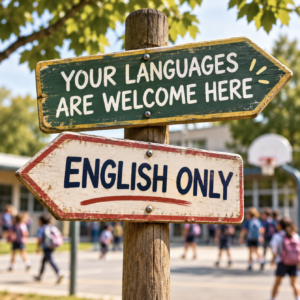
I’ve seen schools with inclusive language policies where students nevertheless experience very different expectations depending on which classroom they enter.
In one classroom, students are encouraged to discuss ideas in their home languages.
In another, they’re expected to use English exclusively — arising out of only good intentions from a teacher doing what she thinks is best practice.
Some teachers deliberately create opportunities for students to use their multilingual repertoires. Others aren’t sure whether doing so is appropriate, or how to make it work in practice.
The school’s stated beliefs may be consistent.
The students’ experiences are not.
That’s why meaningful implementation requires more than sharing a collection of strategies.
Teachers need to understand why particular approaches support learning, how to apply them in different contexts, and how to make informed pedagogical decisions.
They also need time to collaborate, opportunities to reflect on their practice, and clear expectations from school leadership.
The goal isn’t to turn every teacher into a language acquisition specialist.
It’s to ensure that every teacher has the understanding and support necessary to teach the multilingual students in front of them.
And that requires language inclusion to become a shared responsibility rather than something delegated to a particular department.
Translanguaging is more than a teaching technique
There’s another reason I think this conversation is important.
People often discuss translanguaging as though it simply means allowing students to translate, switch between languages, or use their home languages during lessons.
And while these practices can be part of translanguaging pedagogy, the theoretical perspective goes further.
It invites us to examine how students use their linguistic repertoires to make meaning, how schools establish boundaries between languages, and whose linguistic knowledge is recognized as legitimate in educational spaces.
It also challenges us to consider the relationship between language, identity, belonging, and participation.
A classroom strategy might create an opportunity for students to discuss a concept using their home languages.
But a broader translanguaging approach asks whether the classroom environment, assessment practices, and school expectations consistently recognize those languages as resources for learning.
Both the practical and theoretical dimensions are important.
And neither automatically becomes part of classroom practice simply because specialists understand its value.
From common sense to common practice
I keep thinking about the middle-school teacher I mentioned at the beginning.
There’s so much potential in his classroom.
Imagine what might happen if he had opportunities to work alongside a language specialist, explore how multilingual students process information, and experiment with more interactive approaches to teaching.
Imagine what he might notice about his students’ understanding when they were given more opportunities to talk, collaborate, and draw on their full linguistic repertoires.
And imagine what he could contribute to that collaboration through his own subject expertise and knowledge of his students.
That’s the kind of professional learning I want to see more of.
Not isolated workshops where specialists share a few strategies and hope they’ll find their way into classrooms.
But ongoing collaboration that helps teachers develop a shared understanding of language and learning, supported by school-wide expectations and structures.
Because I don’t think the biggest challenge is always figuring out what works.
Sometimes, it’s making sure what we already know reaches the teachers and students who could benefit from it.
Translanguaging doesn’t need to be new to be necessary.
And if we want it to become common practice, we need to make the knowledge behind it accessible to educators across every department, not only those who have spent their careers studying language.
Is language inclusion happening consistently across your school?
Your school may already have experienced language specialists, inclusive policies, and teachers who genuinely value multilingualism.
But does that understanding carry across departments and into everyday classroom practice?
At Conex-Us Consulting, I help schools connect the expertise they already have, build shared understanding of multilingual learning, and create the structures needed for consistent language-inclusive practice.
Explore professional learning and school-wide support
Want to start with your own classroom?
If you’re beginning to explore how students’ home languages can support learning, The Translanguaging Mindset is a self-paced course designed to help you understand the principles behind language-inclusive teaching and apply them purposefully in your classroom.
Explore The Translanguaging Mindset
Next steps: try the free Starter Kit for ten examples you can use this week; take the Multilingual Classroom Checkup to see where your classroom stands; or see how school-wide language inclusion support works.
Related reading: What Professional Development Do Teachers of Multilingual Learners Need? | How Can a School Become More Language-Inclusive? | Common Myths About Translanguaging in International Schools